


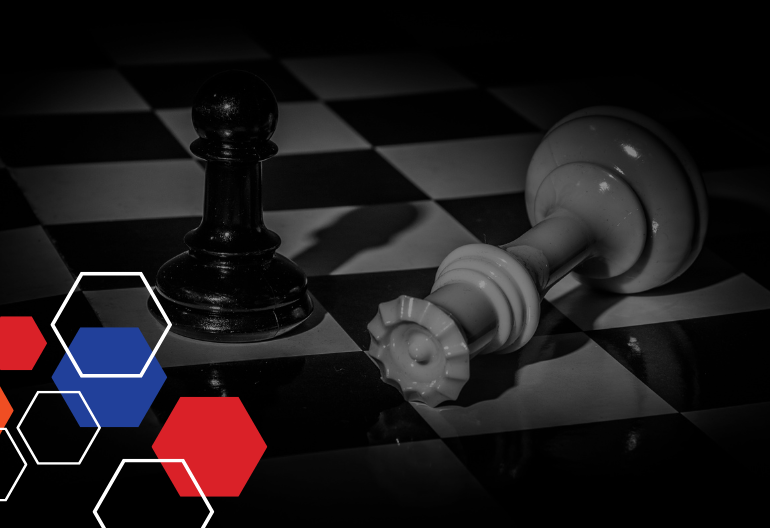
World history and literature are full of stories and legends of underdog leadership: people who have defied the odds of expected defeat. How do they find a way to lead others to success? And what makes underdogs so appealing that we feel compelled to cheer for them?
On episode 143 of The Science of Personality, cohosts Ryne Sherman, PhD, and Blake Loepp spoke with Peter Harms, PhD, Frank Schultz Professor of Management at the University of Alabama’s Culverhouse College of Business, about the psychology of underdog leadership.
Peter first discussed underdogs with Blake and Ryne on “Live from SIOP: The Psychology of Underdogs”, at the 2024 Society for Industrial and Organisational Psychology annual conference. Two years later, he returned for a full-length episode on his recent research.
Read on to learn about characteristics of underdog leaders across history, sports, business, and politics, and how to think like an underdog.
Characteristics of Underdog Leadership
An underdog is a person or group that starts with a disadvantage in a contest that matters where people expect them to lose. In other words, they’re behind in things that normally predict success. We all expect the underdogs to be beaten by the top dogs—but we hope they won’t be.
Peter mentioned Mississippi State football coach Mike Leach as an ideal example of underdog leadership. Leach spent his career at schools that aren’t considered the biggest or best in their states. How should you compete against the top dogs in football when the odds seem impossible? “Leach knew that if he went head-to-head with them using their strategies, they had the personnel, skill, and resources to beat him every time,” Peter explained. As an under-resourced coach, Leach fought against more prominent teams using creative, unorthodox strategies. The reason stories like Leach’s captivate us goes far beyond football.
Universal Appeal of Underdog Heroes
The tale of the underdog acknowledges the universal truth that life is unfair. Myths and legends help humanity make sense of a world in which some people face more challenges with fewer resources than others. The underdog concept also reminds us of childhood, a time when we were underdeveloped and disadvantaged. In the sense that everyone has at some time been a smaller player competing against the odds, being an underdog is a universal experience.
“The underdog story is present in all religions and cultures, where a small, weak person going up against the big, strong champion, and then uses cleverness and adaptability and flexibility to outwit them,” Peter said.
Underdogs can be found nearly everywhere, from ancient myths to popular culture. Some contemporary underdogs are Katniss Everdeen, Optimus Prime, Frodo Baggins, Moana, and Harry Potter. Most of these stories have a subtle educational purpose, modelling how to uphold societal values, such as integrity, teamwork, persistence, and hope. Let’s look at other places where underdogs often stand out.
Underdogs on the Battlefield
At the Battle of Thermopylae in 480 BC, an army of 300 Spartans led by King Leonidas held off a massive force of Persian invaders for three days. But they didn’t win. “Losing battles are sometimes the ones we remember most,” Peter said. “Thermopylae, the Alamo, Dunkirk . . . people making a last stand in the face of overwhelming odds.”
Underdogs on the Athletic Field
Hara Urara, a Japanese racehorse, was famous for losing 113 races in a row and never winning in her entire career. Nicknamed the “Shining Star of Losers Everywhere,” the horse represented the spectators’ daily struggles because she kept trying but never had a victory.
Among the countless other examples of underdogs from sports is wrestler Wyatt Hendrickson’s surprise victory over Olympic gold-medallist Gable Steveson in the last minute of a famous 2025 match. Underdog tactics involve being unconventional and fast. “It’s not letting the other guys rest or playing by their rules,” Peter observed.
Underdogs in the Boardroom
According to Peter, Joseph Campbell’s concept of the hero’s journey, from The Hero with a Thousand Faces, mirrors the overarching myth of the underdog. The book describes an unlikely hero who goes on an adventure, overcomes challenges, and returns home fundamentally changed. “Whenever I watch Shark Tank, I’m watching the hero’s journey,” he said.
The hero’s journey is a familiar story in Silicon Valley, where startups that began in garages have grown into industry-leading tech companies. For instance, OpenAI dominated the early artificial intelligence market with a couple hundred people versus Google’s massive headcount and billions in resources.
Underdogs in Politics
Political figures such as Prime Minister of Singapore Lee Kuan Yew and Mayor of New York City Zohran Mamdani exemplify unexpected success with very few resources. Both showed unconventional strategies and dedicated hard work to earn their appointments. The underdog narrative is often leveraged in US politics, with numerous US presidents running on a platform of working-class, self-made, underprivileged, or bootstrapped success.
Why Do Underdogs Win?
When underdogs win, it satisfies our sense of justice. As an example, in the Judeo-Christian story of David and Goliath, the moral little guy triumphs over the big, bad bully. This outcome seems to restore the world to its rightful order and simply feels fair.
Underdogs can sometimes win when the top dogs fall into the success trap. The success trap is a phenomenon in which a successful person becomes complacent with what they have accumulated and stops taking risks to strive for more. They want to play it safe. In contrast, a successful underdog has a very high tolerance for risk and a vigorous drive to succeed. Safety is not their priority. “Underdogs have that spirit that the big dogs sometimes don’t,” Peter said.
The Underdog Mindset
Peter shared four tips for thinking like an underdog leader:
- Define success – Victory might not mean taking first place. Instead, it might mean recognition or market share or survival.
- Challenge the status quo – People in power will create rules to their own advantage. Underdogs introduce new ideas and change the game to suit their strengths.
- Avoid complacency – The success trap is safe, but it isn’t particularly innovative. Underdogs are willing to relentlessly question their assumptions.
- Rely on others – Underdogs rarely win all by themselves. People who try to do everything alone are likely to burn out, whereas those who embrace their social support networks (that is, teams) overcome obstacles. “Underdogs are not solo heroes,” Peter said.
Listen to this conversation in full on episode 143 of The Science of Personality. Never miss an episode by following us anywhere you get podcasts.
*This article originally appeared on Hogan Assessments.