


Showing Race Fairness in Hogan’s Australian and New Zealand Assessments
Showing Race Fairness in Hogan’s Australian and New Zealand Assessments Organisations that use assessments to make decisions trust those assessments will provide helpful insights (who to hire, where to focus during coaching) without unfairly discriminating against demographic groups. Hogan shares these organisations’ concerns and is committed to ongoing reviews of our assessments’ fairness across age […]
Thought Leadership – Building Your Personal Brand: The Key to Career Success
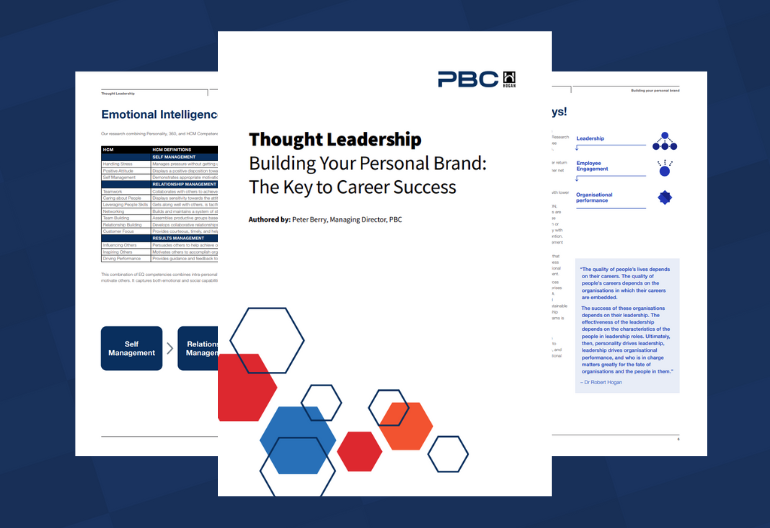
Thought Leadership – Building Your Personal Brand: The Key to Career Success Authored by: Peter Berry, Managing Director, PBC The concept of personal brand has become very popular in the world of leadership and business literature, including Forbes magazine and the Harvard Business Review. Personal brand is about building one’s value proposition to enhance private […]
The Psychology of Humility

Academic psychology maintains that personality should be described in terms of five dimensions—the so-called five-factor model—and that all other dimensions of personality are combinations of these. But this model isn’t as comprehensive as many tend to believe. Consider ambition, for example. Ambition isn’t a factor in the Big Five, but we know it’s an important […]
Strategic Leadership in VUCA Environments

Leaders cannot anticipate every specific situation—not when the world is volatile, uncertain, complex, and ambiguous (VUCA). Knowing how to lead in a VUCA environment doesn’t mean making infinite contingency plans. Instead, it means having flexibility, solving problems, driving change, and handling the unknown. Strategic leadership in the face of VUCA means being versatile when your […]
The Importance of Inclusion and Belonging for Well-Being

Organisations need to consider inclusion and belonging in their employee well-being initiatives. Diversity and equity are important, but inclusion and belonging give diversity and equity meaning. Belonging, especially, is a vital yet intangible outcome of excellent inclusion practices. A well-being initiative that incorporates inclusion and belonging prioritises the unique perspectives that a diverse workforce offers. The inclusion […]
Validity Scale Update
Starting on August 2, Hogan will be making a small update to the Validity statement that appears on some of our reports. The new statement will say, “This report shows a regular assessment pattern,” or “This report shows an irregular assessment pattern.” Here’s why we’re making this change. The quintessential feature of any Hogan […]
Soft Skills Are Having a Moment

Over the past couple of years, a trend has emerged in research and articles about the importance of so-called “soft” skills for leaders. Recently, that thinking seems to be accelerating. Some have suggested that soft skills are the new “hard” skills for leaders.1 Others have suggested that soft skills deserve a rebrand because of their importance […]
Personality, Relationships, and the Psychology of Connection

The link between personality and relationships is complex, to say the least. What compatible personality characteristics help us form positive, long-term human connections? Recently on The Science of Personality, cohosts Ryne Sherman, PhD, and Blake Loepp, discussed personality, relationships, and the psychology of connection. Most of what we feature on our podcast revolves around work and business, but […]
Hogan Assessments Demonstrate Fairness Across Sexual Orientations
Organisations that use assessments to make talent decisions trust those assessments will provide helpful insights about people without unfairly discriminating against demographic groups. Equal employment opportunity for all is one of Hogan’s foundational values, and we are committed to ongoing reviews of our assessments’ fairness. For many years, we have demonstrated the fairness of our assessments […]
Ethical Considerations in Workplace Assessments

With limited guidelines or consensus on how leaders should choose, administer, and debrief their employees and candidates using workplace assessments, practitioners and academics alike need a code of ethics. The American Psychological Association’s Ethics Code and Principles for the Validation and Use of Personnel Section Procedures exist, but talent management professionals need a comprehensive understanding of how to use […]