


The Ultimate Guide to Personality Tests

Personality is the driving force behind human behaviour. At PBC, we eat, sleep, and breathe personality psychology. We study the science of personality, we’ve pioneered the use of personality tests to improve workplace performance, and our tests evaluate all aspects of personality: the bright side, the dark side, and the inside. But we also understand that […]
Balancing Team Engagement and Psychological Safety

Team engagement and psychological safety are both influenced by leadership effectiveness. When both are high, a team likely performs well. But what happens when a team experiences an imbalance? And how can a leader set things right? On episode 151 of The Science of Personality, Melvyn Payne, commercial director at Advanced People Strategies (APS), an authorised Hogan distributor […]
Employee Burnout: Do You Know It When You See It?

When demands on productivity escalate while resource availability and team sizes shrink, the pressure to do more with less fuels stress. With daily stress reaching an all-time high for the second year in a row, employee burnout remains a global challenge.1 Although burnout is the result of unmanaged chronic workplace stress,2 it’s not an exclusively individual […]
The Hidden Cost of Toxic Employees – Why “People Problems” Are Every Leader’s Biggest Challenge

Hogan’s research team has explored the impact of toxic workplace behaviour and the hidden costs toxic employees can create for organisations. The research highlights how leadership and talent issues, particularly those related to problematic employee behaviour, remain central challenges for organisations today. The Pervasive Problem of “People Problems” Hogan’s research highlights that leaders can […]
The Five Human Capabilities That Matter More in the AI Era, and What Personality Can Tell Us About Them

As artificial intelligence becomes increasingly embedded in the way we work, the conversation is shifting. The question is no longer simply, what can AI do? It is also, what will humans need to do exceptionally well? Hogan research highlighted five human capabilities expected to become increasingly valuable in an AI-enabled workplace: Judgement Interpersonal skill Originality […]
Risk-Taking Behavior in Leadership: Finding the Right Balance

At first, the new leader seemed magnetic. People were drawn to the way they dismissed risks, led with excitement, and didn’t worry about consequences. But then things turned. The leader took reckless chances that backfired, ignored commitments to their team, and didn’t acknowledge mistakes. Their behaviour caused discord, stress, and mistrust among the team. At […]
A Focus on Australian Leaders and Business Executives

Australia, a diverse and vibrant nation, is known for its strong economy, high quality of life, and unique geographical position in Asia-Pacific. With a reputation for having a laid-back style with a love of nature, resilience, and optimism, Australia continues to thrive as a hub for global trade, research, and sustainable development. This country’s business […]
The Core5 Model of Leadership Effectiveness
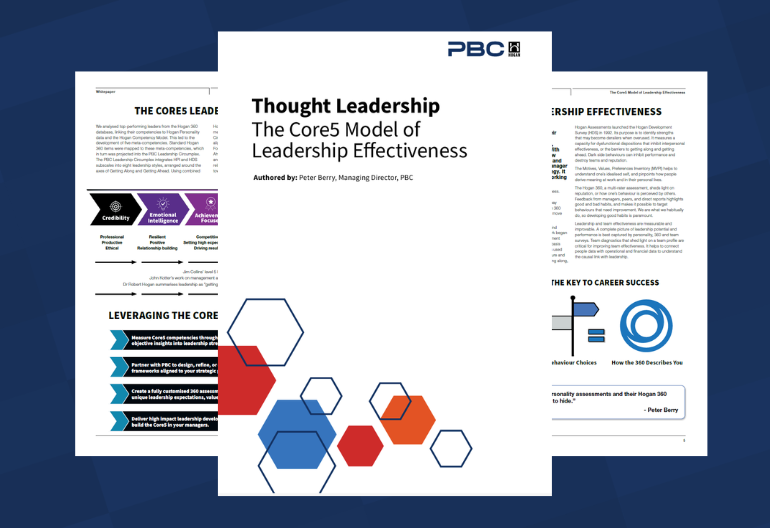
At PBC, we’ve spent decades helping organisations measure and improve leadership. Why? Because leadership drives engagement, and engagement drives performance. Yet so many organisations still get leadership wrong. Our new whitepaper, The Core5 Model of Leadership Effectiveness, introduces a powerful framework that distills what the very best leaders do differently. It combines years of research, […]
Personality and the Secret Life of Organizations

Much of what directs organisational behaviour lies below the surface. Individuals must reconcile organisational goals with their personal goals—often subconsciously. What drives the secret life of organisations? Evolutionary theory and personality psychology. On episode 152 of The Science of Personality, Robert Hogan, PhD, founder and president of Hogan Assessments, discusses his newest book, Personality and the Secret Life of […]
Inside the Manager Engagement Crisis

If your engagement surveys haven’t told you, your organisational performance probably has. Manager engagement has fallen. In fact, the data show that your managers are in crisis. Overall global employee engagement may be down three percentage points since 2022,1 but the manager engagement numbers are even more concerning. Global manager engagement, which was 31% in 2022, […]