



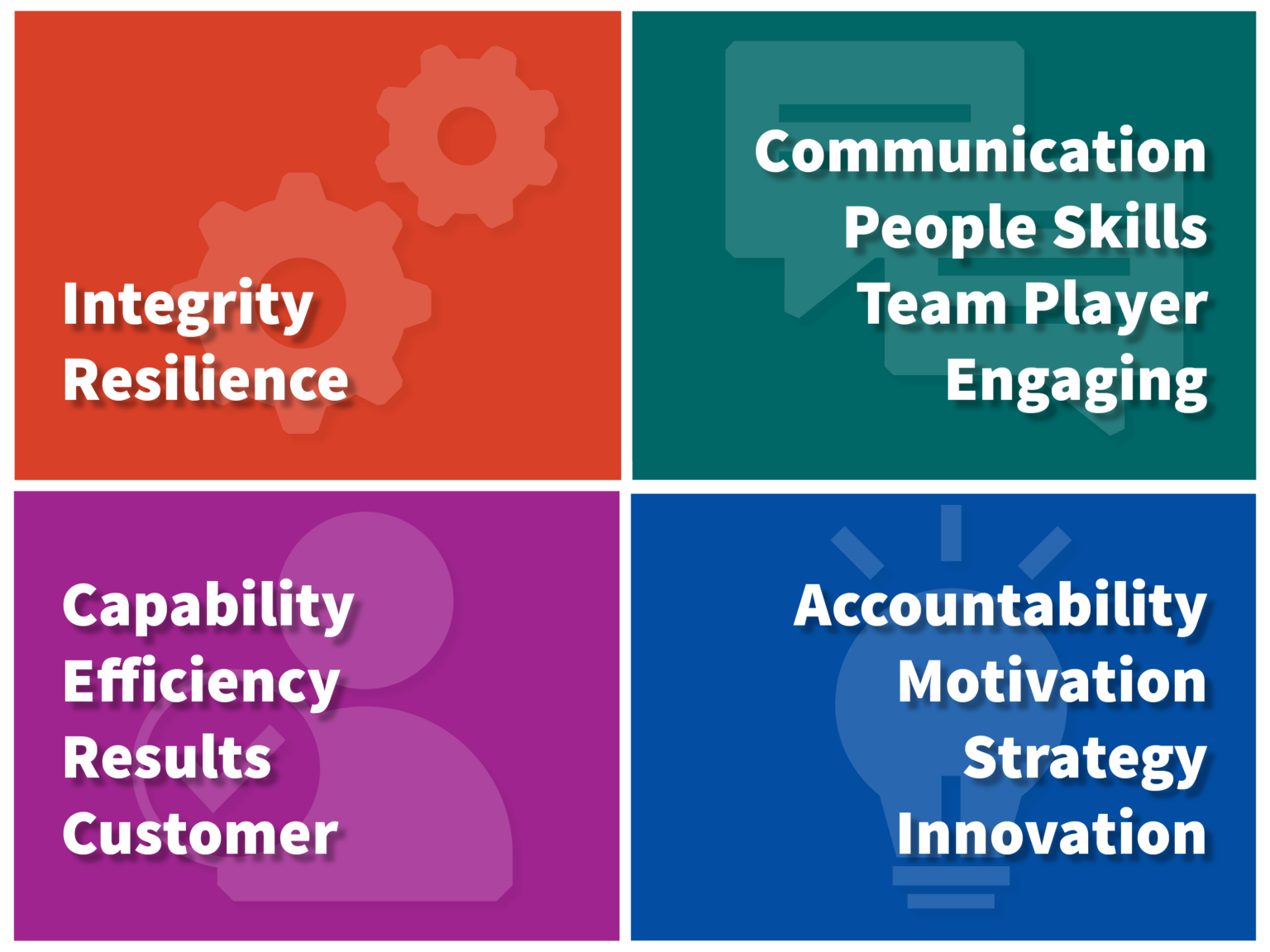
The Hogan 360 Leadership Model consists of four leadership competency quadrants: Self-Management, Relationship Management, Working in the Business, and Working on the Business. Each quadrant of the model comprise sub-themes to allow for greater interpretive power.
Self-Management refers to personal awareness, self-regulation, stress management, resilience, transparency and authenticity. It describes the process of managing one’s emotions maturely to achieve the best outcomes. It may require positive self-talk and recovery periods to fuel peak performance in turbulent times and avoid burnout. Successful self-management requires management of the self and taking care of one’s brand and reputation.
Self-Management consists of the sub-themes Integrity and Resilience:
- Integrity: Serves as a role model for the organisation’s values in relation to treating employees with respect and equity
- Resilience: Maintains emotional maturity even in stressful situations and spends time reflecting on personal improvement opportunities
Relationship Management refers to the ability to achieve better results through better relationships. It is about getting along with others in order to get ahead. It can involve the ability to build trusting, loyal relationships with stakeholders to support retention and performance.
Relationship Management consists of the sub-themes Communication, People Skills, Team Player, and Engaging:
- Communication: Has clarity and professionalism in communication style and message
- People Skills: Engages with others and is approachable and authentic
- Team Player: Actively builds team functionality and cohesion
- Engaging: Brings positive energy to the workplace
Working in the Business refers to having the experience, capability, and efficiency to consistently deliver great results. It requires having the energy, passion, and competitive drive to stay in the performance zone. Success in this area can involve smarter prioritisation of work, more delegation, better time management, and more effective goal setting. It is about achieving service and operational excellence in a timely, efficient manner.
Working in the Business consists of the sub-themes Capability, Efficiency, Results, and Customer:
- Capability: Has the requisite ability and experience to do one’s current role
- Efficiency: Prioritises and manages time and effort for maximum benefit
- Results: Delivers on commitments and expectations to a high standard
- Customer: Is driven by internal and external customer needs to drive improvement
Working on the Business refers to adding extra value through innovation and strategic planning and building motivated, accountable teams. Success in this area can involve long-term planning to achieve competitive advantage and delivering results through high-performing cultures. Leading change requires spending more time on the business, having a planning cycle, conducting regular planning reviews, and challenging poor performers.
Working on the Business consists of the sub-themes Accountability, Motivation, Strategy, and Innovation:
- Accountability: Manages performance by providing consistent and constructive feedback
- Motivation: Creates a work environment that allows everyone to become engaged
- Strategy: Spends time thinking long term and shares vision with others
- Innovation: Suggests and supports ideas that improve processes and deliverables