


A team under strain
Picture this: a team of 9 in the operations arm of a mid-sized financial services firm. A restructuring removed a layer of management and two colleagues, and the remaining team shared their work. A new system was due within six months to replace the one everyone was used to, and the targets stayed exactly where they were. Senior leaders called it a chance to do things differently. The team, being committed, responded the way dedicated teams do with longer hours, more meetings, more effort.For a while, performance was stable. Then small cracks started to appear. In the corridor and on private chat, the same line kept surfacing: “we can’t keep this up.” Two people, each confident they knew what mattered most, spent a fortnight on overlapping work. When the new system did not function optimally, people went back to their old spreadsheets rather than raise it in a team meeting where concerns were now rarely aired at all. Decisions that once took a conversation took three meetings. People became protective of their workloads and frustrated with colleagues they saw as not pulling their weight, and the high performers carried an increasing share of the workload while others withdrew. Six months later, two of the strongest people had resigned, engagement had fallen, and deadlines were being missed, despite everyone working harder than ever.
It would be easy to blame the restructure, the new system or a few individuals who could not hold the line. None of these fully explain the dynamics that led to this final result. What had failed was the team’s capacity to absorb sustained pressure and adapt, and more effort did not restore it. In an environment where change had become the norm, fragility had replaced adaptability.
Why teams, and what “effective” means
All organisations experience periods of instability. This could be driven by broader forces like politics and the economy, or more localised, where perhaps there is a change in leadership or restructuring occurs. Yet regardless of the nature of these disruptions, organisations are expected to navigate uncertainty while continuing to deliver results. They lean heavily on teams to do it, for good reason. A team that works well is sharper than any one person in it, with shared perspectives in decision-making to avoid blind spots and benefit from complementary expertise.That is a conditional claim, though. Hackman suggests that whether a team beats its members working alone depends far more on how it is set up and led than merely having the label of team.1 So, it helps to be precise here: by a team we mean two or more people who interact, share goals and depend on one another’s work to achieve them.2
What makes such a team effective? Hackman’s answer has three parts: the people who receive the work rate that work as good, the team becomes more capable of working together over time, and its members leave better for the experience than they were before. The third part deserves attention. How many teams have you belonged to that left you energised rather than drained? Most measures of team performance stop at the first part: financial results, delivery volume, quality, etc. The second and third are where resilience often resides. A team that cannot adapt to setbacks risks poorer decisions, weaker collaboration and less innovation over time, while its members become more stressed, disengaged and exposed to burnout.
What team resilience is
Researchers define team resilience as “a team’s capacity to bounce back from adversity-induced process loss”.3 In simple terms, process loss is where team coordination and effort get disrupted due to an event that creates adversity and induces stress. Adversity need not be a global shock like a pandemic; it can be a key member or leader leaving, a regulatory change, or an operational breakdown. Team resilience in these moments has been linked to stronger team and project performance, greater team creativity and, for senior leadership teams, improved organisational outcomes such as financial performance or the organisation’s ability to adapt to new environmental requirements.4At this stage, it is important to highlight two points related to the nature of team resilience. First, team resilience is not individual results averaged out across the team. A team of resilient individuals is not automatically a resilient team.5
Second, the research points to four collective resources a team draws on when adversity hits. In the academic literature, these four appear as team potency (collective belief they can achieve difficult things), teams’ mental models of teamwork (shared understanding of ways of working), team capacity to improvise (adapting and adjusting appropriately), and team psychological safety (the safety to speak up and take risks). Kirkman and Stoverink provide more accessible terms where needed calling the four resources team confidence, teamwork roadmaps, capacity to improvise and psychological safety.6 A caution is warranted here as research on team resilience is growing rather than settled. Treat what follows as a well-grounded way of thinking based on current evidence, not a settled framework.
Where the Four Horsemen come from
A team that cannot adapt through change and grow is fragile because it responds in a rigid way to what is thrown at it. Across the literature and our consulting work, we see fragility appear in four recognisable ways, where each team resource starts to erode. We call them the Four Horsemen of Team Fragility: Doubt, Drift, Defaulting and Distrust. To be clear, the four resources come from research on team resilience as noted earlier. The Four Ds are our PBC framework for describing what it can look like when those resources start to erode. They are practical indicators that help to identify trouble early, not a validated diagnostic measure.Identifying the signs of Team Fragility
Each D is something you can observe, and each helps identify a possible shortfall in one of the four resources.1. Team Confidence vs Doubt: “We can’t do this”
Team potency, or team confidence, is the shared belief that the group can succeed through whatever comes its way. It is a collective belief, not the sum of individual self-belief, and it matters most where people depend on each other.7When confidence erodes, teams can fall into Doubt, where problems feel overwhelming, initiative declines, and the team loses belief in its ability to succeed. Something to try: Confidence tends to follow evidence. Break the pressure into pieces of work the team can win, then celebrate what it has already achieved. Leaders who point only at the gap to their target usually deepen Doubt.2. Shared Ways of Working vs Drift: everyone pulling their own way
A shared mental model of teamwork refers to a common understanding of who does what, who needs what from whom, and how decisions get made. Teams with shared models coordinate and perform better.8 A model built for old conditions can become no longer fit for purpose when circumstances change and the team does not revisit it. Teams can begin to Drift when this shared understanding weakens, leading to different priorities, mixed messages and poor coordination. Something to try: Redraw the roadmap out loud and together whenever conditions shift. You can also look to answer three questions together: what matters most now, who owns what, and how will we make decisions and share information?3. Collective Improvisation vs Defaulting: retreating to the old playbook
This refers to a limited capacity to improvise rather than adapting quickly when the plan no longer fits. Defaulting is not a character flaw. Staw and colleagues showed that threat makes groups narrow their focus, tighten control and fall back on well-rehearsed responses.9 Expect it, forecast it, and then you are better able to plan for it. Teams lapse into Defaulting when their capability to improvise is lacking and they start relying on familiar routines, waiting for direction, or applying solutions that no longer fit the situation. Something to try: Agree in advance where people may depart from procedure without asking, and rehearse a few “what if” scenarios so that improvising is not happening for the first time under stress.4. Psychological Safety vs Distrust: staying quiet rather than speaking up
Psychological safety is a shared belief that it is safe to take interpersonal risks such as admitting an error or expressing disagreement.10 It is often mistaken for niceness, but it is really what allows hard things to be said early because there is a high-level of trust between team members. Meta-analytic evidence links it to information sharing, learning, and performance.11 When psychological safety is low, teams can slip into Distrust, where people protect themselves by withholding information, avoiding challenge and remaining silent about emerging issues. Something to try: Leaders need to go first by naming their own uncertainty, asking directly for dissent, and treating the first piece of bad news heard as information, not an accusation. How it is received sets the norm for whether the next issue or concern is shared.How the Horsemen feed into each other
The Four Horsemen are symptoms of a shortfall in the underlying resource. The symptoms also feed one another; for example, a team that stops sharing information (Distrust) loses sight of shared priorities (Drift). A team that has drifted misses what has changed and retreats to routine (Defaulting). Routine fails to fit the problem, setbacks accumulate, confidence within the team goes (Doubt), and people become more guarded. That sequence is our reading of what can often happen in teams, not an established causal order, but it explains why a small crack left alone can lead to a knock-on effect across the team. The Four Horsemen are not causes of fragility in themselves. They are observable signs that a team’s capacity to adapt, recover and perform under pressure may be starting to weaken.What you can do
Team resilience is not static
It waxes and wanes, and you can develop it, so a risk identified for a team today does not have to define a team’s future. A quick fix or one-off intervention will most likely disappoint, so keep monitoring and managing. While the evidence that team resilience matters is strong, the evidence for which team-level interventions work best is still contentious, so start small, tweak and check if things change. Timing also matters. Alliger and colleagues distinguish strategies used before adversity strikes (minimising), during it (managing) and after it (mending).12 Before adversity strikes, strengthen the four resources while doing so is cheaper. During adversity, watch for the 4 Ds and redraw the roadmap as conditions shift. Afterwards, review what happened, repair trust where it may have fractured and carry the lessons back into how the team works.The leader’s role
Leaders shape the conditions in which the four resources grow or wear away.13In practice this means creating clarity on purpose and priorities (guarding against Drift), encouraging constructive challenge and learning (countering Defaulting), making progress visible so that confidence has something to rest on (mitigating Doubt), and making it safe to speak up when problems emerge (reducing Distrust).Choosing and inheriting teams
Who is on a team may make resilience more or less likely, so selecting based on what a team needs is worth thinking about. If you have inherited a team, individual assessments can help, with some caveats. As team resilience is not the sum of individual resilience, a profile cannot tell you whether a whole team system is resilient. It can show how particular people tend to behave under pressure, and so where a pattern like Drift or Distrust is most likely to start.A quick self-check
If you would like a practical way to reflect on your team’s resilience, use the Four Horsemen of Team Fragility framework as a quick sense-check. You can start by asking yourself: Which of these patterns appears most often in my team today? The answer may reveal where attention and conversation are needed before small issues become larger challenges.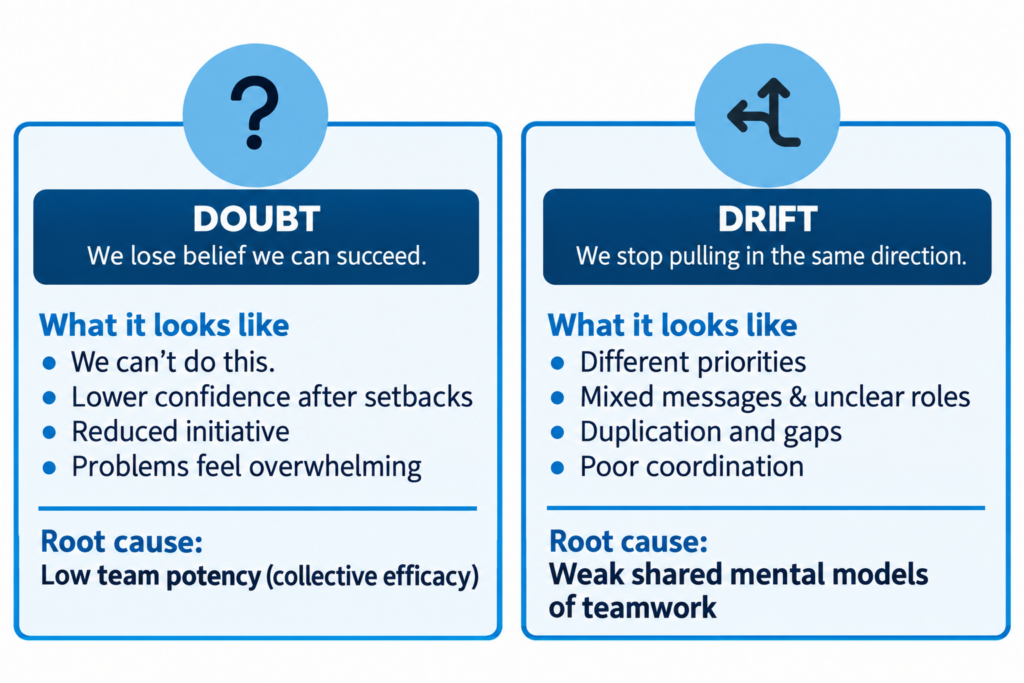
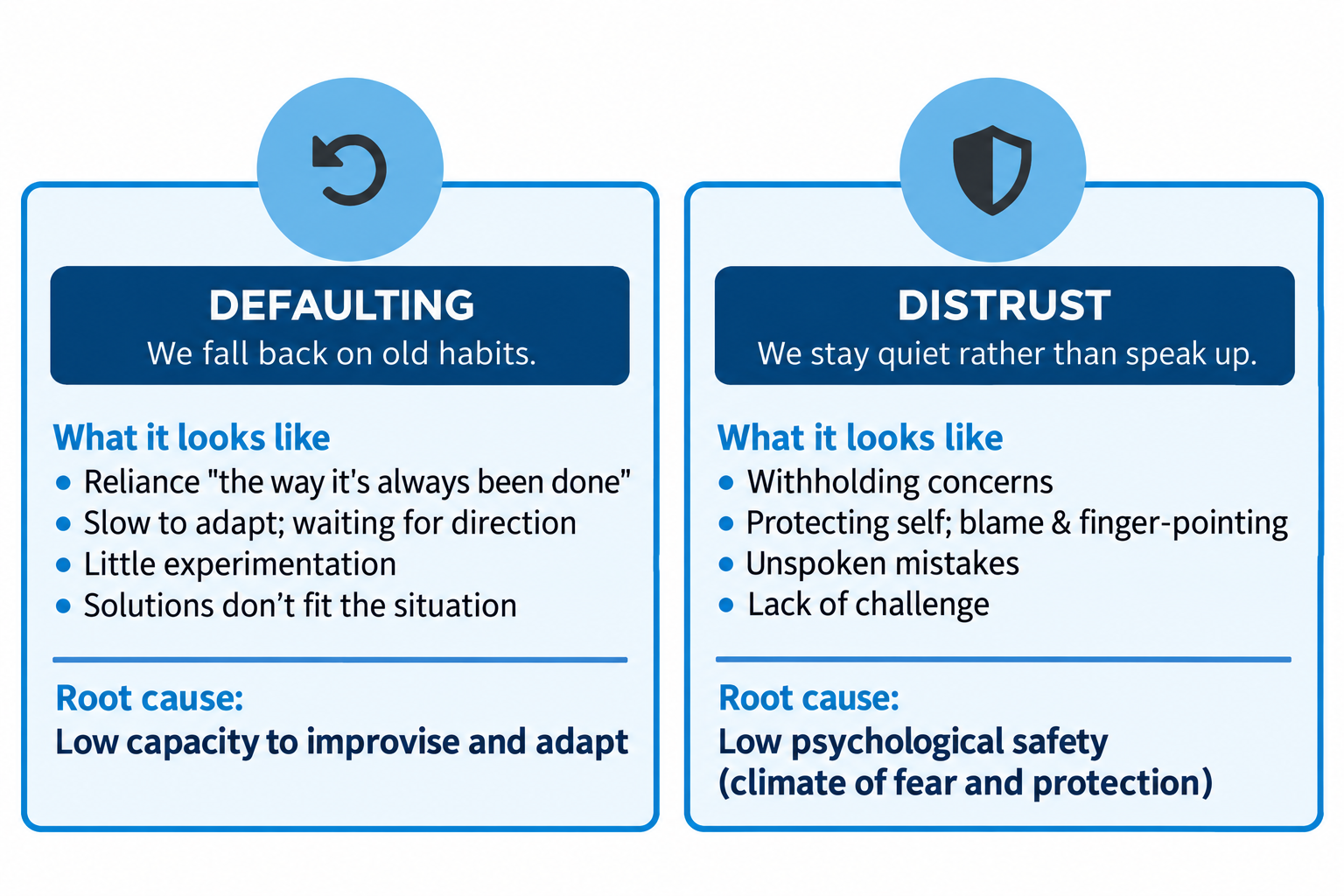 While the framework draws on current research into team resilience and effectiveness, it is not a validated diagnostic tool. Think of it as a conversation starter that can help identify areas worth exploring more deeply.
If you would like to go further, at PBC we work with leaders on team effectiveness, coaching, psychometric assessment and facilitated team interventions designed to strengthen a team’s ability to adapt, recover and perform under pressure.
While the framework draws on current research into team resilience and effectiveness, it is not a validated diagnostic tool. Think of it as a conversation starter that can help identify areas worth exploring more deeply.
If you would like to go further, at PBC we work with leaders on team effectiveness, coaching, psychometric assessment and facilitated team interventions designed to strengthen a team’s ability to adapt, recover and perform under pressure.